Prospective Graduate Students Back to the Main Page
 Take the Tour | Videos | Application Information | Request Information | Online Application | Application Status | Q&A
home :: people :: faculty
Print    Email

Stephen E. Bradforth

Professor of Chemistry
Physical Chemistry

Ph.D., 1992, University of California, Berkeley
B.A., 1987, Cambridge University
Office: SSC 726
Phone: (213) 740-0461
Fax: (213) 740-3972
Email: stephen.bradforth@usc.edu
 Group Homepage


Research Focus


The research in the Bradforth group centers on understanding the ultrafast dynamics of chemical reactions in solution and in complex condensed phase systems. The common strand in our experiments is to explore the coupling of the dynamics of the nuclei (e.g. vibrations, bond formation/breaking and solvent motion) to a given non-adiabatic electronic process. The time scales for these non-adiabatic processes are on the order of 100 fs; likewise the timescales of nuclear motions are 10 fs - 1 ps. In a condensed environment, this allows only a short time window to explore the system evolution and catch the newly-formed products before complete relaxation. Femtosecond spectroscopy is therefore the appropriate experimental technique to elucidate the dynamics.

Most small molecule photochemistry that is well characterized in the gas phase takes place at wavelengths shorter than 350 nm. Our group follows reactions of such molecules when embedded in a liquid. However, the ultraviolet is traditionally a difficult area for ultrashort pulse generation. We have recently harnessed developments in hollow core fiber technology to achieve breakthrough tunable deep UV pulses of ~ 25 fs. When combined with fully dispersed spectral probing we carry out solution photochemistry experiments exploiting this unprecedented time resolution.

Experimental projects using ultrafast spectroscopy in the Bradforth group include (i) probing the primary pathways for electron ionization and detachment in liquid water (ii) investigating chemistry initiated by ejection of an ultrafast electron, (iii) the influence of solvent on bond dissociation dynamics and on rotational relaxation initiated by photodissociation, (iv) determining pathways of energy migration of an electronic excitation through an organized architecture of chromophores such as DNA. Strong connection with current theory is emphasized in all projects. In addition, we are engaged in several collaborative projects with theoreticians in the areas of electronic structure and quantum dynamics of solutes in bulk liquids.

Solution photodetachment and photodissociation

Photoionization and photodetachment are well-understood processes in vacuum. Our experiments build a molecular level picture of the dynamics of electron ejection in liquids. We have now firmly established mechanisms for the resonant detachment of many simple anionic systems. These experiments have allowed development of solution-based photodetachment spectroscopy for exploring reaction dynamics in liquids, such as descent from a bimolecular barrier and contact reactions of bimolecular partners who would normally meet by diffusion. In addition we are actively exploring the photophysics of liquid water, the nature of the conduction band in water and mechanisms of liquid photoionization. This fundamental work is of crucial importance in understanding the effects of radiation on animal tissue, and hazardous waste storage.

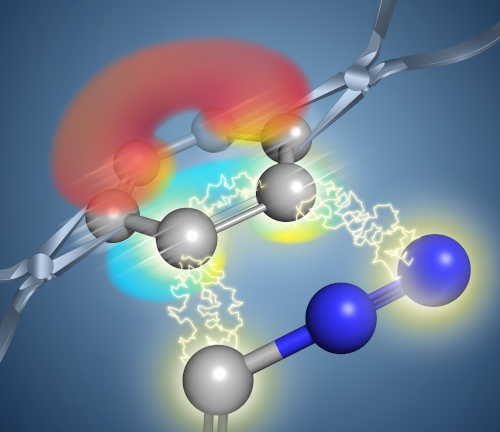
Photodissociation studies of benchmark systems such as ICN in polar liquids reveal unusually long-lived free rotor behavior in the very hot product fragment. This allows a new probe of liquid rotational friction. Our experiments characterize a reaction-induced change in the liquid structure which leads to a breakdown in the linear response type dissipative behavior of the solvent. In addition, curve-crossing dynamics in the photodissociation can be disentangled in a full liquid environment.

DNA and Aromatic photophysics: Energy Transfer in Chromophore Arrays

X-ray crystallography reveals that nature uses cyclic architectures of chlorophyll pigments to achieve phenomenal efficiency in photosynthetic light harvesting. Polymer analogs to the supramolecular pigment architectures employed in photosynthesis have been synthesized by Prof. Hogen-Esch of this department. These chromophore arrays successfully harvest electronic energy by efficient energy transfer between chromophores. In contrast, UV excitation of DNA – another ordered chromophore array – leads to damage and mutagenesis. Patterns of damage in oligonucleotides may be connected with energy transfer along base stacks in DNA and the increased excited state lifetime in the polymer. Using time-domain spectroscopy, our group is studying energy transfer dynamics in both macrocyclic polymers and in DNA. Fluorescence and time resolved absorption anisotropy and annihilation are being used to analyze energy migration pathways and timescales. We have recently observed via dispersed pump-probe spectroscopy that there are sub-100fs pathways for electronic relaxation in constituent DNA bases.

Selected publications

 
1.

"Differential Effects of β-Mercaptoethanol on CdSe/ZnS and InP/ZnS Quantum Dots", M. Georgin, L. Carlini, D. Cooper, S. E. Bradforth, and J. L. Nadeau, Phys. Chem. Chem. Phys., submitted (2012).

2.

"Relative effects of electron elastic and inelastic scattering in liquid water revealed by photoelectron spectroscopy", S. Thürmer, R. Seidel, M. Faubel, W. Eberhardt, J. C. Hemminger, S. E. Bradforth, and B. Winter, Phys. Rev. Lett., submitted (2012).

3.

"On the nature and origin of the reactive molecular species formed in liquid water upon X-ray irradiation", S. Thürmer, M. Ončák, N. Ottosson, R. Seidel, U. Hergenhahn, S. E. Bradforth, P. Slavíček, and B. Winter, Nat. Chem., submitted (2012).

4.

"Emission of Macrocyclic and Linear Poly(2-vinylnaphthalene): Observation of Two Excimer Populations in Macrocycles", G. G. Nossarev, J. Johnson, S. E. Bradforth, and T. E. Hogen-Esch, J. Phys. Chem. B, submitted (2012).

5.

"General Discussion", S. E. Bradforth, Farad. Discuss 157, 243-84 (2012).

6.

"Contrasting the excited state reaction pathways of phenol and para-methylthiophenol in the gas and liquid phases", Y. Zhang, T. A. A. Oliver, M. N. R. Ashfold, and S. E. Bradforth, Farad. Discuss 157, 141-63 (2012).

7.

"Efficient Singlet Fission Discovered in a Disordered Acene Film", S. T. Roberts, R. E. McAnally, J. N. Mastron, D. H. Webber, M. T. Whited, R. L. Brutchey, M. E. Thompson, and S. E. Bradforth, J. Am. Chem. Soc. 134, 6388-400 (2012).

8.

"Effects of β-Mercaptoethanol on Quantum Dot Emission Evaluated from Photoluminescence Decays", J. L. Nadeau, L. Carlini, D. Suffern, O. Ivanova, and S. E. Bradforth, J. Phys. Chem. C 116, 2728–39 (2012).

9.

"Improving Open Circuit Potential in Hybrid P3HT:CdSe Bulk Heterojunction Solar Cells via Colloidal tert-Butylthiol Ligand Exchange", M. Greaney, S. Das, D. H. Webber, S. E. Bradforth, and R. L. Brutchey, ACS Nano 6, 4222-30 (2012).

10.

"First-Principle Protocol for Calculating Ionization Energies and Redox Potentials of Solvated Molecules and Ions: Theory and Application to Aqueous Phenol and Phenolate", D. Ghosh, A. Roy, R. Seidel, B. Winter, S. E. Bradforth, and A. I. Krylov, J. Phys. Chem. B 116, 7269-80 (2012).

11.

"Symmetry-Breaking Intramolecular Charge Transfer in the Excited State of meso-Linked BODIPY Dyads", M. T. Whited, N. M. Patel, S. T. Roberts, K. Allen, P. I. Djurovich, S. E. Bradforth, and M. E. Thompson, Chem. Comm. 48, 284-6 (2012).

12.

"Chasing charge localization and chemical reactivity following photoionization in liquid water", O. Marsalek, C. G. Elles, P. A. Pieniazek, E. Pluhařová, J. VandeVondele, S. E. Bradforth, and P. Jungwirth, J. Chem. Phys. 135, 224510(1-14) (2011).

13.

"Ultrafast hybridization screening in Fe3+ aqueous solution", S. Thürmer, R. Seidel, W. Eberhardt, S. E. Bradforth, and B. Winter, J. Am. Chem. Soc. 133, 12528 -35 (2011).

14.

"Wavelength dependence of ultraviolet radiation-induced DNA damage as determined by near monochromatic laser irradiation suggests that cyclobutane pyrimidine dimers are the principal DNA lesions produced by terrestrial sunlight", A. Besaratinia, J.-i. Yoon, C. Schroeder, M. Cockburn, S. E. Bradforth, and G. P. Pfeifer, FASEB Journal 25, 3079-91 (2011).

15.

"General Discussion", S. E. Bradforth, Farad. Discuss 150, 505-32 (2011).

16.

"Linking Photochemistry in the Gas and Solution Phase: S-H bond Fission in p-Methylthiophenol Following UV Photoexcitation", T. A. A. Oliver, Y. Zhang, M. N. R. Ashfold, and S. E. Bradforth, Farad. Discuss 150, 439 - 58 (2011).

17.

"The dynamical role of solvent on the ICN photodissociation reaction: connecting experimental observables directly with molecular dynamics simulations", C. A. Rivera, N. Winter, R. V. Harper, I. Benjamin, and S. E. Bradforth, Phys. Chem. Chem. Phys. 13, 8269-83 (2011).

18.

"Tracking State-to-State Bimolecular Reaction Dynamics in Solution", S. E. Bradforth, Science 331, 1398-9 (2011).

19.

"Observation of Triplet Exciton Formation in a Platinum-Sensitized Organic Photovoltaic Device", S. T. Roberts, C. W. Schlenker, V. Barlier, R. E. McAnally, Y. Zhang, J. N. Mastron, M. E. Thompson, and S. E. Bradforth, J. Phys. Chem. Lett. 2, 48-54 (2011).

20.

"Ionization of Purine Tautomers in Nucleobases, Nucleosides, and Nucleotides: From the Gas Phase to the Aqueous Environment", E. Pluhařová, P. Jungwirth, S. E. Bradforth, and P. Slavíček, J. Phys. Chem. B 115, 1294–305 (2011).

21.

"Broadband spectral probing revealing ultrafast photochemical branching after ultraviolet excitation of the aqueous phenolate anion", X. Chen, D. S. Larsen, S. E. Bradforth, and I. H. M. van Stokkum, J. Phys. Chem. A 115, 3807-19 (2011).

22.

"Singlet and Triplet Excitation Management in a Bichromophoric NIR-Phosphorescent BODIPY-Benzoporphyrin Platinum Complex", M. T. Whited, P. I. Djurovich, S. T. Roberts, A. C. Durrell, C. W. Schlenker, S. E. Bradforth, and M. E. Thompson, J. Am. Chem. Soc. 133, 88-96 (2010).

23.

"Gires-Tournois interferometer type negative dispersion mirrors for deep ultraviolet pulse compression", C. A. Rivera, S. E. Bradforth, and G. Tempea, Opt. Express 18, 18615-24 (2010). link

24.

"Interfacial charge transfer between CdTe quantum dots and Gram negative vs. Gram positive bacteria", D. Cooper, E. Dumas, L. Carlini, C. Gao, D. Suffern, S. E. Bradforth, and J. L. Nadeau, Environmental Science and Technology 44, 1464-70 (2010).

25.

"Photoelectron spectroscopy of liquid water and aqueous solution: Electron effective attenuation lengths and emission-angle anisotropy ", N. Ottosson, M. Faubel, S. E. Bradforth, P. Jungwirth, and B. Winter, J. Electron. Spec. 177, 60-70 (2010).

26.

"Hydrogen forms in water by proton transfer to a distorted electron", O. Maršálek, T. Frigato, J. VandeVondele, S. E. Bradforth, B. Schmidt, C. Schütte, and P. Jungwirth, J. Phys. Chem. B 114, 915–20 (2010).

27.

"Synthesis and Spectroscopy of Poly(9,9-dihexylfluorene-2,7-diyl-co-9,9-dihexylfluorene-3,6-diyl)s and Their Model Oligomers", N. Fomina, S. E. Bradforth, and T. E. Hogen-Esch, Macromolecules 42, 6440-7 (2009).

28.

"Ionization energies of aqueous pyrimidine components of nucleic acids by photoelectron spectroscopy and ab initio calculations", P. Slavíček, B. Winter, M. Faubel, S. E. Bradforth, and P. Jungwirth, J. Am. Chem. Soc. 131, 6460–7 (2009).

29.

"Photoenhancement of Lifetimes in CdSe/ZnS and CdTe Quantum Dot-Dopamine Conjugates", D. Cooper, L. Carlini, S. Clarke, D. Suffern, R. Parbhoo, S. E. Bradforth, and J. Nadeau, Phys. Chem. Chem. Phys. 11, 4298 - 310 (2009).

30.

"The degree of initial hole localization/delocalization in ionized water clusters", P. A. Pieniazek, E. J. Sundstrom, S. E. Bradforth, and A. I. Krylov, J. Phys. Chem. A 113, 4423–9 (2009).

31.

"Photoenhancement of quantum dots and conjugates measured by time-resolved spectroscopy", D. Suffern, D. Cooper, L. Carlini, R. Parbhoo, S. E. Bradforth, and J. Nadeau, Proc. SPIE -Int. Soc. Opt. Eng. 7189, 718905 (2009).

32.

"Electronic structure of liquid water from polarization-dependent two-photon absorption spectroscopy", C. G. Elles, C. Rivera, X. Zhang, P. A. Pieniazek, and S. E. Bradforth, J. Chem. Phys. 130, 084501 (2009).

33.

"Electronic structure of the water dimer cation", P. A. Pieniazek, J. vandeVondele, P. Jungwirth, A. I. Krylov, and S. E. Bradforth, J. Phys. Chem. A 112, 6159–70 (cover article) (2008).

34.

"Charge localization and Jahn–Teller distortions in the benzene dimer cation", P. A. Pieniazek, S. E. Bradforth, and A. I. Krylov, J. Chem. Phys. 129, 074104 (1-11) (2008).

35.

"Investigation of macrocyclic polymers as artificial light harvesters: sub-picosecond energy transfer in poly(9,9-dimethyl-2-vinyl-fluorene)", J. M. Johnson, R. Chen, X. Chen, A. C. Moskun, X. Zhang, T. E. Hogen-Esch, and S. E. Bradforth, J. Phys. Chem. B 112, 16367–81 (2008).

36.

"Photoionization of atmospheric gases studied by time-resolved terahertz spectroscopy", Z. Mics, P. Kužel, P. Jungwirth, and S. E. Bradforth, Chem. Phys. Lett. 465, 20-4 (2008).

37.

"The Ultrafast Dynamics of Photodetachment", X. Chen and S. E. Bradforth, Annu. Rev. Phys. Chem. 59, 203-31 (2008).

38.

"Electronic Structure of the benzene dimer cation", P. A. Pieniazek, A. I. Krylov, and S. E. Bradforth, J. Chem. Phys. 127, 044317(1-16) (2007).

39.

"Benchmark full configuration interaction and EOM-IP-CCSD results for prototypical charge transfer systems: Non-covalent ionized dimers", P. A. Pieniazek, S. A. Arnstein, S. E. Bradforth, A. I. Krylov, and C. D. Sherrill, J. Chem. Phys. 127, 164110 (2007).

40.

"Excited state dynamics of liquid water: Insight from the dissociation reaction following two-photon excitation", C. G. Elles, I. Shkrob, R. A. Crowell, and S. E. Bradforth, J. Chem. Phys. 126, 164503 (1-8) (2007).

41.

"Excitation-energy dependence of the mechanism for two-photon ionization of liquid H2O and D2O from 8.3 to 12.4 eV", C. G. Elles, A. E. Jailaubekov, R. A. Crowell, and S. E. Bradforth, J. Chem. Phys. 125, 044515 (1-12) (2006).

42.

"Labeling of subcellular redox potential with dopamine-conjugated quantum dots", D. Suffern, S. J. Clarke, C. A. Hollmann, D. Bahcheli, S. E. Bradforth, and J. L. Nadeau, Proc. SPIE - Int. Soc. Opt. Eng. 6096, 60960O (2006).

43.

"Electron Photodetachment from aqueous anions. III. Dynamics of Geminate Pairs derived from photoexcitation of mono- vs. poly- atomic anions", R. Lian, D. Oulianov, R. A. Crowell, I. A. Shkrob, X. Chen, and S. E. Bradforth, J. Phys. Chem. A 110, 9071-8 (2006).

44.

"Reluctant to leave parent: A different spectroscopic look at liquid salty water", B. Winter, I. V. Hertel, C. Pettenkofer, S. E. Bradforth, and M. Faubel, BESSY Highlights 2005 (2006).

45.

"Absence of a Signature of Aqueous I(2P1/2) after 200-nm Photodetachment of I-(aq)", A. C. Moskun, S. E. Bradforth, J. Thogersen, and S. Keiding, J. Phys. Chem. A 110, 10947-55 (2006).

46.

"Rotational Coherence and a Sudden Breakdown in Linear Response Seen in Room-Temperature Liquids", A. C. Moskun, A. E. Jailaubekov, S. E. Bradforth, G. Tao, and R. M. Stratt, Science 311, 1907-11 (2006).

47.

"Photophysics of electron-donor modified quantum dots and effects on biological systems", S. J. Clarke, C. A. Hollmann, Z. Zhang, D. Suffern, S. E. Bradforth, N. M. Dimitrijevic, W. G. Minarik, and J. L. Nadeau, Nat. Mater. 5, 409-17 (2006).

48.

"Spectroscopy of the cyano radical in an aqueous environment", P. A. Pieniazek, S. E. Bradforth, and A. I. Krylov, J. Phys. Chem. A 110, 4854-65 (cover article) (2006).

49.

"Electron binding energies of hydrated H3O+ and OH- : Photoelectron spectroscopy of aqueous acid and base solutions combined with electronic structure calculations", B. Winter, M. Faubel, I. V. Hertel, C. Pettenkofer, S. E. Bradforth, B. Jagoda-Cwiklik, L. Cwiklik, and P. Jungwirth, J. Am. Chem. Soc. 128, 3864-5 (2006).

50.

"Mechanisms of Quantum Dot Interactions with Biological Cells", J. L. Nadeau, S. J. Clarke, R. A. Khatchadouriana, D. M. Bahchelia, D. Suffern, and S. E. Bradforth, Proc. SPIE - Int. Soc. Opt. Eng. 5969, 596907 (2005).

51.

"Tunable 30-femtosecond pulses across the deep ultraviolet", A. E. Jailaubekov and S. E. Bradforth, Appl. Phys. Lett. 87, 021107 (1-3) (2005).

52.

"Nonresonant ionization of oxygen molecules by femtosecond pulses: plasma dynamics studied by time-resolved terahertz spectroscopy", Z. Mics, F. Kadlec, P. Kuzel, P. Jungwirth, S. E. Bradforth, and V. A. Apkarian, J. Chem. Phys. 123, 104310 (1-10) (2005).

53.

"Photo-physical properties of biologically compatible CdSe quantum dot structures", J. A. Kloepfer, S. E. Bradforth, and J. Nadeau, J. Phys. Chem. B 109, 9996-10003 (2005).

54.

"Solvent effects on geminate recombination dynamics after photodetachment", V. H. Vilchiz, X. Y. Chen, J. A. Kloepfer, and S. E. Bradforth, Rad. Phys. Chem. 72, 159-67 (2005).

55.

"Role of water in electron-initiated processes and radical chemistry: Issues and scientific advances", B. C. Garrett, D. A. Dixon, D. M. Camaioni, D. M. Chipman, M. A. Johnson, C. D. Jonah, G. A. Kimmel, J. H. Miller, T. N. Rescigno, P. J. Rossky et al., Chem. Rev. 105, 355-89 (2005).

56.

"Electron binding energies of aqueous alkali and halide ions: EUV photoelectron spectroscopy of liquid solutions and combined ab initio and molecular dynamics calculations", B. Winter, R. Weber, I. V. Hertel, M. Faubel, P. Jungwirth, E. C. Brown, and S. E. Bradforth, J. Am. Chem. Soc. 127, 7203-14 (2005).

57.

"Ultrafast dynamics for electron photodetachment from aqueous hydroxide", R. A. Crowell, R. Lian, I. A. Shkrob, D. M. Bartels, X. Y. Chen, and S. E. Bradforth, J. Chem. Phys. 120, 11712-25 (2004).

58.

"Electron photodetachment from aqueous anions. 2. Ionic strength effect on geminate recombination dynamics and quantum yield for hydrated electron", M. C. Sauer, I. A. Shkrob, R. Lian, R. A. Crowell, D. M. Bartels, X. Y. Chen, D. Suffern, and S. E. Bradforth, J. Phys. Chem. A 108, 10414-25 (2004).

59.

"Molecular Mechanisms for Photodetachment in Water", J. A. Kloepfer, V. H. Vilchiz, V. A. Lenchenkov, and S. E. Bradforth, in Ultrafast Phenomena XIII, edited by D. Miller, M. M. Murnane, N. F. Scherer, and A. M. Weiner (Springer Verlag, Berlin, 2003), pp. 471-3.

60.

"Photodissociation of ICN in polar solvents: evidence of long lived rotational excitation in real liquids", A. C. Germaine and S. E. Bradforth, in Ultrafast Phenomena XIII, edited by D. Miller, M. M. Murnane, N. F. Scherer, and A. M. Weiner (Springer-Verlag, Berlin, 2003), pp. 426-8.

61.

"Photodissociation of ICN in polar solvents: Evidence for long lived rotational excitation in room temperature liquids", A. C. Moskun and S. E. Bradforth, J. Chem. Phys. 119, 4500-15 (2003).

62.

"Flowing liquid sample jet for resonance Raman and ultrafast optical spectroscopy", M. J. Tauber, R. A. Mathies, X. Y. Chen, and S. E. Bradforth, Rev. Sci. Ins. 74, 4958-60 (2003).

63.

"Ultraviolet absorption and fluorescence emission spectroscopic studies of macrocyclic and linear poly(9,9-dimethyl-2-vinylfluorene). Evidence for ground-state chromophore interactions", R. Chen, J. M. Johnson, S. E. Bradforth, and T. E. Hogen-Esch, Macromolecules 36, 9966-70 (2003).

64.

"Spectroscopy of macrocyclic poly (9,9-dimethyl-2-vinylfluorene) as an artificial light harvester", J. M. Johnson, X. Chen, A. C. Germaine, X. Zhang, K. Alberty, T. E. Hogen-Esch, and S. E. Bradforth, in Ultrafast Phenomena XIII, edited by D. Miller, M. M. Murnane, N. F. Scherer, and A. M. Weiner (Springer-Verlag, Berlin, 2003), pp. 517-9.

65.

"Excited states of iodide anions in water: A comparison of the electronic structure in clusters and in bulk solution", S. E. Bradforth and P. Jungwirth, J. Phys. Chem. A 106, 1286-98 (2002).

66.

"Characterization and fluorescence of macrocyclic polystyrene by anionic end to end coupling. Role of coupling reagents", K. A. Alberty, E. Tillman, S. Carlotti, K. King, S. E. Bradforth, T. E. Hogen-Esch, D. Parker, and W. J. Feast, Macromolecules 35, 3856-65 (2002).

67.

"Time-resolved scavenging and recombination dynamics from I : e- caged pairs", J. A. Kloepfer, V. H. Vilchiz, V. A. Lenchenkov, X. Y. Chen, and S. E. Bradforth, J. Chem. Phys. 117, 766-78 (2002).

68.

"Electron photodetachment in solution", J. A. Kloepfer, V. H. Vilchiz, V. A. Lenchenkov, and S. E. Bradforth, in Liquid Dynamics: Experiment, Simulation, and Theory, edited by J. Fourkas (ACS Books, Washington, D.C., 2002), Vol. 820, pp. 108-21.

69.

"Map for the relaxation dynamics of hot photoelectrons injected into liquid water via anion threshold photodetachment and above threshold solvent ionization", V. H. Vilchiz, J. A. Kloepfer, A. C. Germaine, V. A. Lenchenkov, and S. E. Bradforth, J. Phys. Chem. A 105, 1711-23 (2001).

70.

"Electron photodetachment from [Fe(CN)6]4-: photoelectron relaxation and geminate recombination", V. Lenchenkov, J. Kloepfer, V. Vilchiz, and S. E. Bradforth, Chem. Phys. Lett. 342, 277-86 (2001).

71.

"Cyclic polystyrene by anionic polymerization: fluorescence studies", K. A. Alberty, E. Tillman, S. Carlotti, S. E. Bradforth, and T. E. Hogen-Esch, ACS Div. Polym. Sci. Polym. Prepr. 42, 584-5 (2000).

72.

"Ultrafast thermalization dynamics of hot photoelectrons injected into water", V. H. Vilchiz, J. A.Kloepfer, A. C. Germaine, V. A. Lenchenkov, and S. E. Bradforth, in Springer Series Chem, edited by T. Elsaesser, S. Mukamel, M. M. Murnane, and N. F. Scherer (Springer-Verlag, Berlin, 2000), pp. 467-9.

73.

"Femtosecond Study of Electron Photodetachment from Complex Anions: Fe(CN)64 - and CuBr2- in H2O", V. A. Lenchenkov, V. H. Vilchiz, J. A. Kloepfer, and S. E. Bradforth, in Springer Series Chem, edited by T. Elsaesser, S. Mukamel, M. M. Murnane, and N. F. Scherer (Springer-Verlag, Berlin, 2000), pp. 476-8.

74.

"The ejection distribution of solvated electrons generated by the one-photon photodetachment of aqueous I- and two-photon ionization of the solvent", J. A. Kloepfer, V. H. Vilchiz, V. A. Lenchenkov, A. C. Germaine, and S. E. Bradforth, J. Chem. Phys. 113, 6288-307 (2000).

75.

"Femtosecond dynamics of photodetachment of the iodide anion in solution: resonant excitation into the charge-transfer-to-solvent state", J. A. Kloepfer, V. H. Vilchiz, V. A. Lenchenkov, and S. E. Bradforth, Chem. Phys. Lett. 298, 120-8 (1998).


Chemistry Dept., USC College of Letters, Arts & Sciences